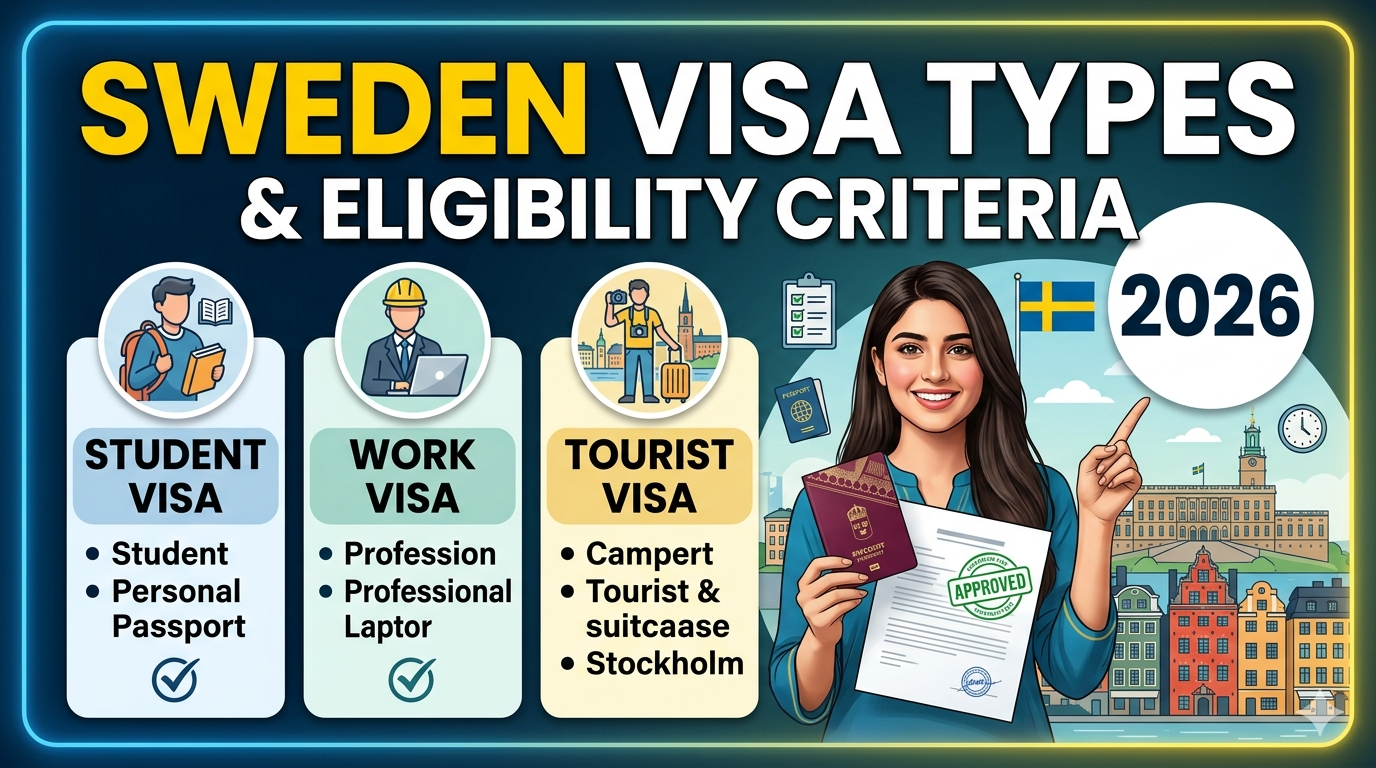
Understand different Sweden visa types and eligibility rules for 2026 in one simple guide. Whether you are applying for study, work, or visit visa, learn what suits you best and how to qualify. Explore your options and take the next step now.
Introduction to Sweden Visa System
Understand different Sweden visa types and eligibility rules for 2026 in one simple guide. Whether you are applying for study, work, or visit visa, learn what suits you best and how to qualify. Explore your options and take the next step now.
Sweden has quietly become one of the most desirable destinations for travelers, students, and skilled professionals. With its strong economy, world-class education system, and unmatched quality of life, it’s no surprise that thousands of people apply for a Sweden visa every year. But here’s the thing—understanding the Sweden visa types and eligibility criteria in 2026 can feel like decoding a complex puzzle if you’re not familiar with the system.
Sweden follows the Schengen visa framework, which means short-term travel rules are aligned with other European countries. A Schengen visa allows stays of up to 90 days within a 180-day period . However, if you’re planning to stay longer—whether for work, study, or family—you’ll need a residence permit, not just a visa.
Think of it like this: a visa is your entry ticket, while a residence permit is your long-term pass to stay and build a life in Sweden.
In 2026, the system has become even more structured, with digital applications, biometric verification, and stricter eligibility checks. Whether you’re applying from Pakistan or anywhere else, the process now emphasizes financial stability, clear purpose of travel, and documentation accuracy.
Why Sweden Attracts Global Applicants
Sweden isn’t just another European country—it’s a lifestyle upgrade. Imagine living in a place where innovation meets nature, where work-life balance is not just a buzzword but a reality.
From tech hubs in Stockholm to scenic countryside landscapes, Sweden offers opportunities across multiple sectors. Students benefit from globally recognized universities, while professionals enjoy competitive salaries and employee rights.
The country also has a transparent immigration system. Decisions are handled by the Swedish Migration Agency, which evaluates applications for visas, residence permits, and citizenship .
But here’s the catch: Sweden doesn’t hand out visas casually. You need to meet strict eligibility criteria—and that’s exactly what we’re about to break down.
Overview of Visa vs Residence Permit
This is where many applicants get confused.
A visa is typically for short stays—tourism, business trips, or visiting family. It’s limited in duration and doesn’t allow long-term activities like full-time work.
On the other hand, a residence permit is required if you plan to stay longer than 90 days. Whether you’re studying, working, or joining family, this permit becomes your legal basis for living in Sweden.
In fact, Sweden does not issue traditional “long-term visas” for most purposes. Instead, long stays are handled through residence permits issued before entry .
Sweden Visa Categories Explained
Understanding visa categories is like choosing the right lane on a highway—pick the wrong one, and you’ll end up delayed or rejected.
Short-Stay Visas (Type A & C)
Short-stay visas are designed for temporary visits.
Transit Visa (Type A)
This visa is for travelers passing through a Swedish airport en route to another destination. It doesn’t allow entry into Sweden itself—only the international transit area.
It’s mainly required for nationals of certain countries and is rarely used compared to other visa types.
Schengen Visa (Type C)
This is the most common visa.
It allows you to stay in Sweden and the entire Schengen area for up to 90 days. People use it for:
- Tourism
- Business meetings
- Family visits
- Conferences
However, it does not allow employment or long-term residence .
Long-Stay Visas (Type D)
National Visa (Type D)
This visa is issued in special cases where a stay longer than 90 days is required temporarily. It’s not very common and usually applies to urgent or exceptional situations.
Residence Permits Overview
For anything long-term—study, work, or family—you’ll need a residence permit.
These permits are purpose-specific and must be approved before entering Sweden. Processing can take several months, so planning ahead is crucial.
Tourist Visa (Schengen Type C)
Eligibility Criteria
To qualify for a tourist visa, you need to prove that your visit is temporary and that you’ll return home after your stay.
Key eligibility factors include:
- Valid passport (issued within 10 years)
- Proof of sufficient funds
- Travel itinerary
- Travel insurance
- Strong ties to your home country
Applicants must also show that they can financially support themselves during their stay. This is critical—Sweden wants to ensure visitors won’t become a burden on the system.
Required Documents
The documentation process is detailed and must be handled carefully.
You’ll typically need:
- Completed visa application form
- Passport-sized photos
- Bank statements
- Proof of accommodation
- Flight reservations
- Travel insurance
Applications are usually submitted through embassies or authorized centers like VFS Global, where biometrics are collected .
Sweden Work Visa / Work Permit
Eligibility Requirements
Sweden doesn’t offer a traditional “work visa.” Instead, you apply for a work permit, which acts as your legal authorization to live and work in the country.
To qualify:
- You must have a job offer from a Swedish employer
- The job must be advertised in the EU/EEA first
- Your salary must meet Swedish standards
This ensures fair competition and protects local labor markets.
Salary and Job Conditions
Your salary must align with Swedish collective agreements or industry standards. Employers must also provide:
- Health insurance
- Employment contract
- Proper working conditions
Without these, your application will likely be rejected.
Sweden Student Visa
Eligibility Criteria
Planning to study in Sweden? You’ll need a residence permit for studies.
Requirements include:
- Admission to a recognized institution
- Proof of tuition fee payment
- Financial proof to support living expenses
Financial Requirements
Students must show they can support themselves financially during their stay. This typically includes:
- Bank statements
- Scholarship proof (if applicable)
Without financial stability, approval chances drop significantly.
Family Reunification Visa
Who Can Apply
This visa allows family members to join someone already living in Sweden.
Eligible applicants include:
- Spouses or partners
- Children
- In some cases, parents
Sponsorship Requirements
The sponsor in Sweden must:
- Provide proof of income
- Have suitable accommodation
This ensures that the incoming family member will be properly supported.
Sweden Business Visa
Eligibility and Purpose
Business visas fall under the Schengen category and are used for:
- Meetings
- Conferences
- Short-term projects
Required Documentation
Applicants must provide:
- Invitation letter from a Swedish company
- Business registration documents
- Financial proof
Sweden Visa Application Process 2026
Step-by-Step Process
- Determine visa type
- Gather documents
- Book appointment
- Submit application
- Provide biometrics
- Wait for decision
Processing usually takes around 15 days for short-stay visas .
Processing Time and Fees
| Visa Type | Processing Time | Fee |
|---|---|---|
| Schengen Visa | ~15 days | €80 |
| Work Permit | 1–3 months | Varies |
| Student Permit | 1–3 months | Varies |
Key Changes in Sweden Visa Rules 2026
ETIAS Introduction
Starting late 2026, visa-exempt travelers must apply for ETIAS authorization, costing around €7 .
Updated Requirements
New updates include:
- Biometric verification
- Digital applications
- Stricter financial checks
Common Reasons for Visa Rejection
Visa rejections often happen due to:
- Incomplete documentation
- Insufficient funds
- Weak travel purpose
- Lack of ties to home country
Tips to Increase Visa Approval Chances
Want to improve your chances?
Focus on:
- Strong financial proof
- Clear travel purpose
- Accurate documentation
- Early application
Think of your application as a story—you need to convince the visa officer that everything adds up logically.
Conclusion
Navigating the Sweden visa types and eligibility criteria in 2026 might seem overwhelming at first, but once you break it down, it becomes manageable. The key lies in understanding whether your stay is short-term or long-term and choosing the right category accordingly.
Sweden offers incredible opportunities—but only to those who prepare properly. From gathering documents to meeting financial requirements, every step matters. Treat your visa application like an investment in your future, and you’ll significantly increase your chances of success.